
- Land Clearing
- Forestry Mulching
Don't Burn It, Grind It: Land Clearing During Oklahoma Burn Bans
A burn ban can stall a burn job while the equipment sits on your property. Here is what Oklahoma law allows, what those days really cost, and why we tell customers to grind it instead.

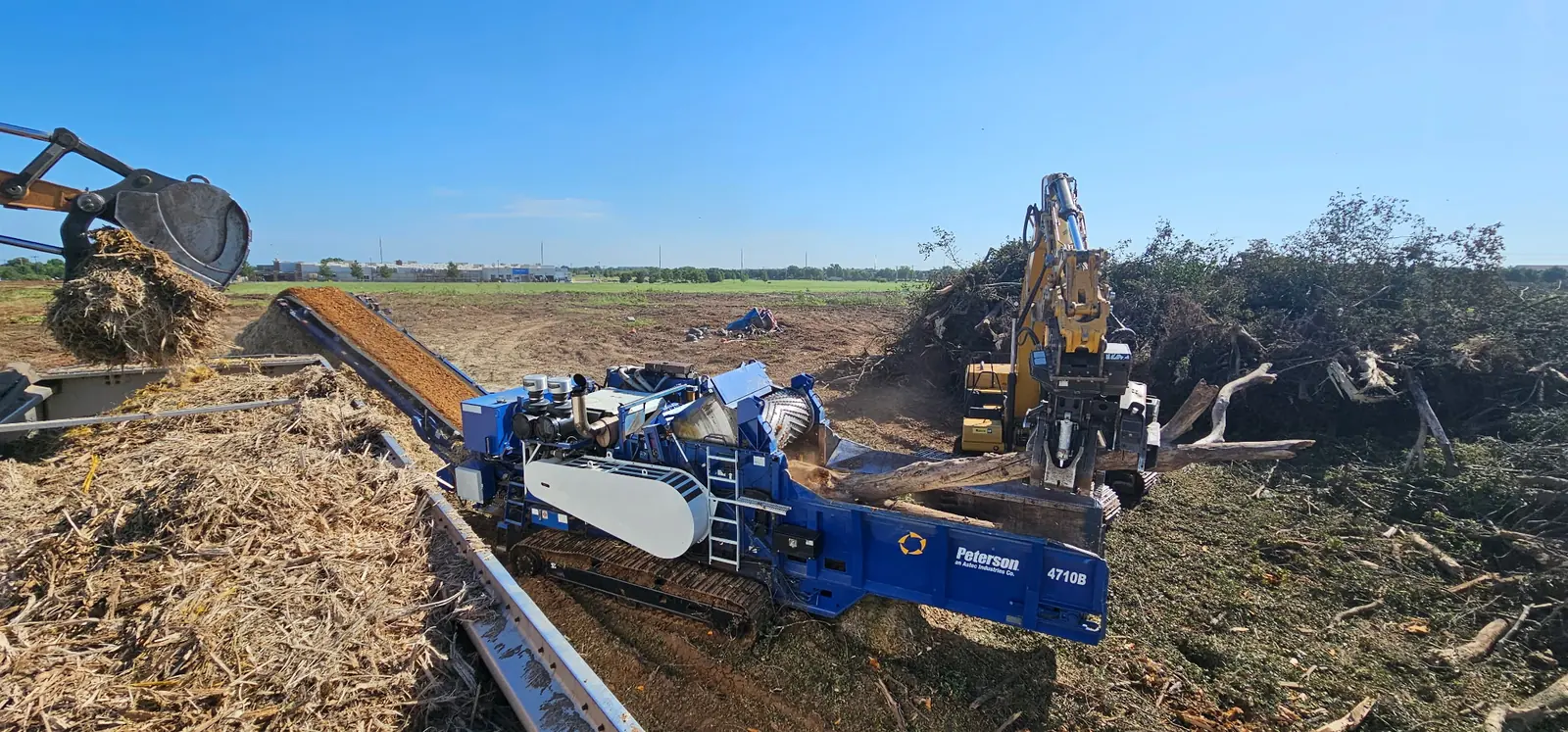
You can’t burn brush piles during most Oklahoma burn bans, and on a land clearing job that matters more than people expect. Every day the piles sit waiting for a legal burn day, the equipment sits on your property too, and you are paying for those days. That’s why we give customers the same advice we follow ourselves: you shouldn’t burn it, grind it.
Grinding costs more up front. It is still the better call on most jobs in a dry Oklahoma fall, and the reasons have less to do with the burn itself than with everything that happens around it.
What a burn ban actually stops
Oklahoma has two kinds of burn bans, and they are not the same.
| County burn ban | Governor’s burn ban | |
|---|---|---|
| Declared by | County commissioners, with a majority of the county’s fire chiefs agreeing | The Governor, on the advice of Oklahoma Forestry Services |
| What it does | Restricts open burning, with any exceptions written into the resolution | Prohibits controlled burning and prescribed fire |
| How long | Up to 14 days, and it can be passed again if the danger continues | Until another proclamation ends it |
| Violation | A misdemeanor, with a fine and up to a year in jail | A misdemeanor, with a higher fine and up to a year in jail |
The detail that surprises people is how a county ban gets triggered. Under the criteria Oklahoma Forestry Services publishes, the county has to be in severe, extreme or exceptional drought, with no more than half an inch of rain in the three-day forecast. Then one more condition has to be true: either fire activity is well above normal for the season, or more than 20 percent of the county’s wildfires have been caused by escaped debris burns or controlled burns. In other words, Oklahoma writes escaped burn piles directly into the reason the burning gets shut off.
There’s an agricultural exception during county bans that people sometimes count on. Forestry Services’ summary of burning law says producers burning cropland, rangeland, forests or pastures as a management practice can still burn with a written prescribed burn plan filed with the fire department. That is written for managing land with fire, not for getting rid of a clearing job’s brush piles, and it does nothing under a Governor’s ban.
Oklahoma Forestry Services links its current county burn ban map from its Forestry Services page. Check it, then check your county’s own resolution for exceptions.
Even without a ban, burning a clearing job has rules
A burn ban is the obvious stop. The everyday rules are the ones that slow burn jobs down without anyone announcing it. The Oklahoma DEQ’s open burning rules for land clearing set out several conditions:
- 500 feet from homes. OAC 252:100-13-7 allows land clearing fires only at least 500 feet from any occupied residence that is not on the same property. On a lot clearing job near a subdivision, that can rule burning out entirely.
- A daylight window. Under OAC 252:100-13-9, burning can only start between three hours after sunrise and three hours before sunset, and no fuel can be added outside that window. In late fall that is a short working day for a burn crew.
- No burning on air alert days. The same rule bars burning on any day an Ozone or PM Alert is declared for the county, and it can’t put smoke across a road, a rail line or an airfield.
- No open piles in the biggest counties. Under OAC 252:100-13-8, counties with more than 500,000 people, which includes Oklahoma County, require land clearing debris to be burned in an air curtain incinerator instead of an open pile. If you are anywhere in the OKC metro, call DEQ before planning a burn.
None of those rules apply to grinding. A grinder doesn’t care what the drought monitor says, how close the neighbors are, or whether it’s an air alert day.
The cost nobody puts in the quote: burn ban days
This is the part of the burning versus grinding decision that only shows up once the job is underway.
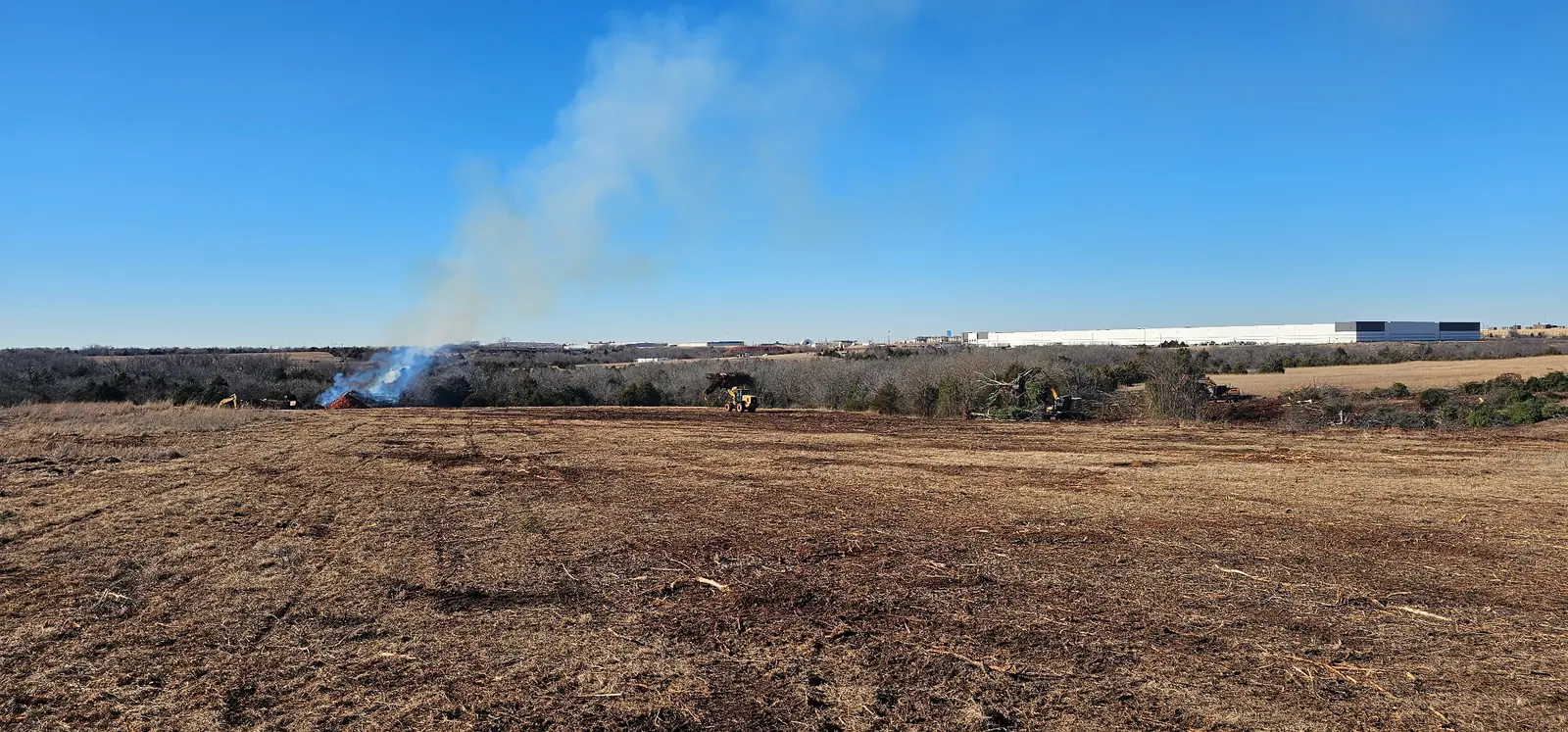
On a burn job, the brush gets cleared and stacked, and then the piles have to wait for a legal burn day. During a burn ban, that wait has no end date you can count on. The equipment doesn’t leave, because the job isn’t done until the piles are gone. Every burn ban day is another day the equipment sits on your property, and another day you are paying for it. In a dry fall, county bans are often passed again and again, two weeks at a time.
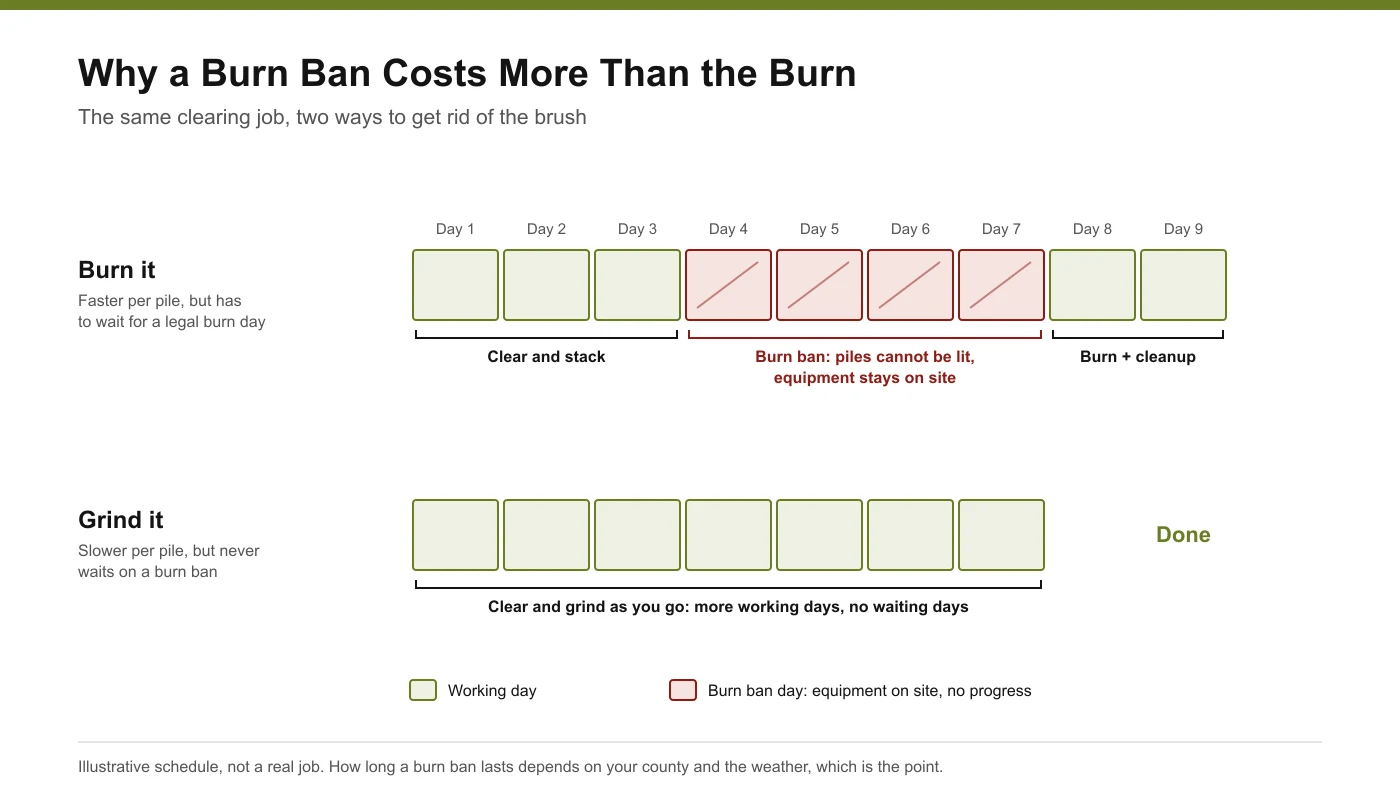
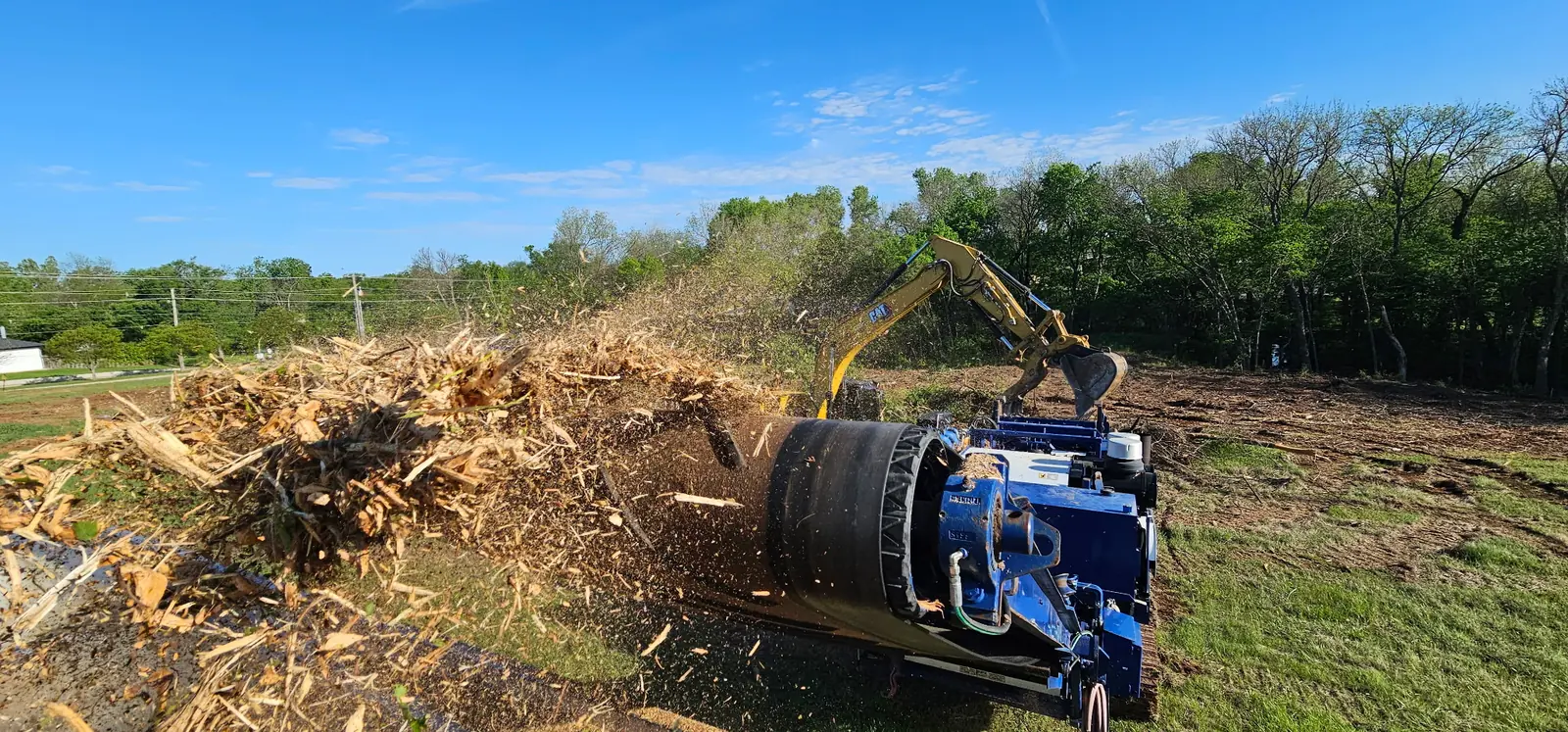
Grinding works differently. The brush goes through the grinder as it comes down, so there are no piles waiting on the weather. The job takes more working days, but it doesn’t take waiting days.
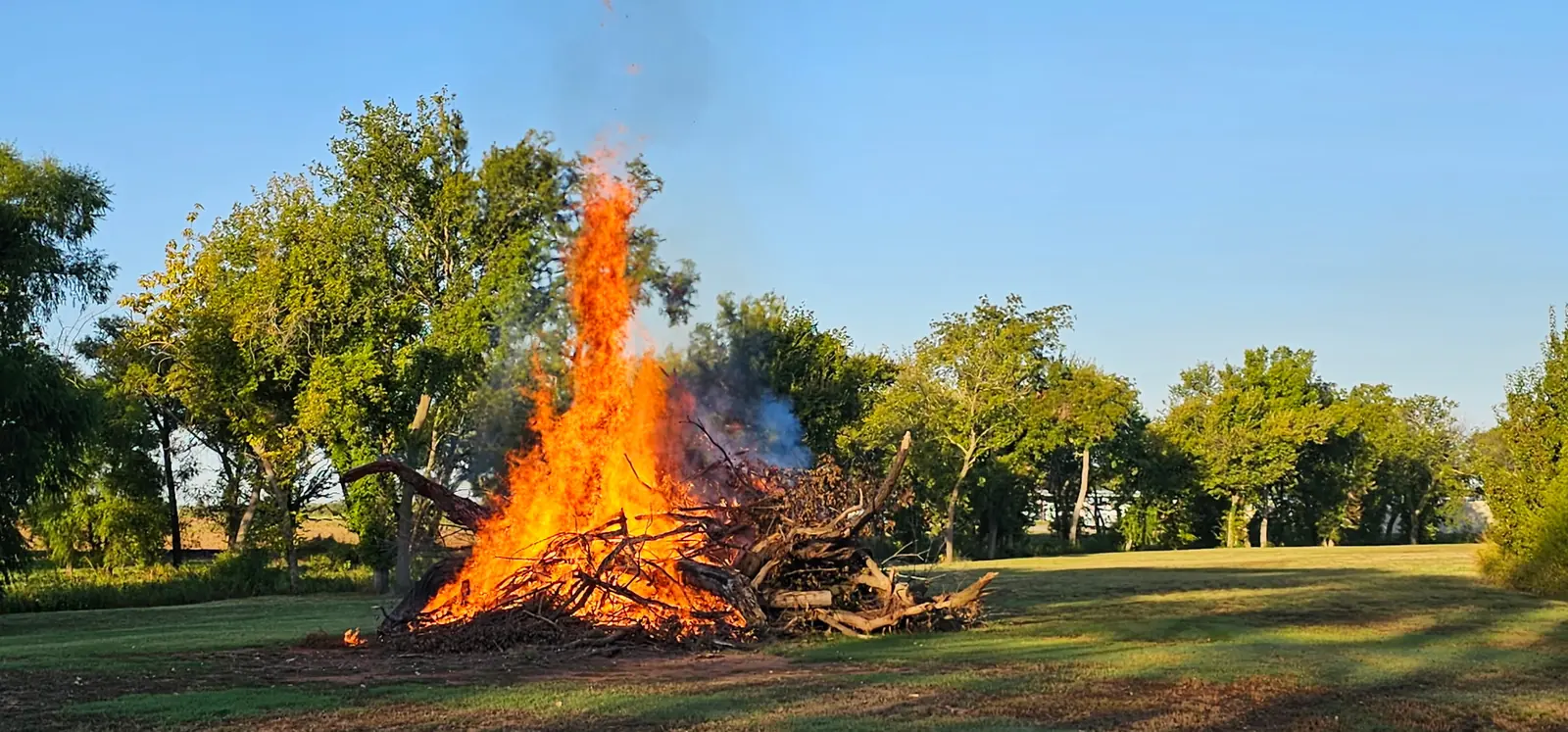
A burn pile on one of our clearing jobs, a few yards from the treeline. On a dry, windy day, that treeline is the problem.
Why grinding costs more up front, and why it’s usually still the cheaper job
Here is the honest version. Grinding usually costs more up front than burning. A horizontal grinder is one of the most expensive machines in the industry, it has to be on your property longer, and feeding brush through it is slower than lighting a match.
That math only holds if the burn days come when you need them. On a burn job, burn ban days and short burn windows turn into equipment days you didn’t plan for. On a grind job, the schedule is the schedule. In a wet spring with no bans, burning may well come out ahead. In a dry Oklahoma fall, with bans renewed every two weeks, the cheaper option on paper often isn’t the cheaper job.
Then there’s the risk you can’t put a number on until something goes wrong:
- Liability for an escaped fire. Oklahoma Forestry Services and many fire departments can charge for the reasonable cost of suppressing an illegal or escaped controlled burn (2 O.S. § 16-32), on top of whatever the fire damages.
- Red Flag days. A Red Flag Warning is not a burn ban, but Forestry Services warns that anyone whose burn escapes after being lit during one could be considered willfully or grossly negligent.
- Smoke. Smoke from a burn crosses property lines, roads and the neighbors’ windows. Wood chips don’t.
The fire risk isn’t theoretical
Across the United States, debris and open burning is the single biggest human cause of wildfires. USDA Forest Service fire-occurrence data from 1992 to 2024, summarized by Headwaters Economics, counts more than 611,000 wildfires started by debris and open burning, which they call by far the top category of human-caused wildfires.
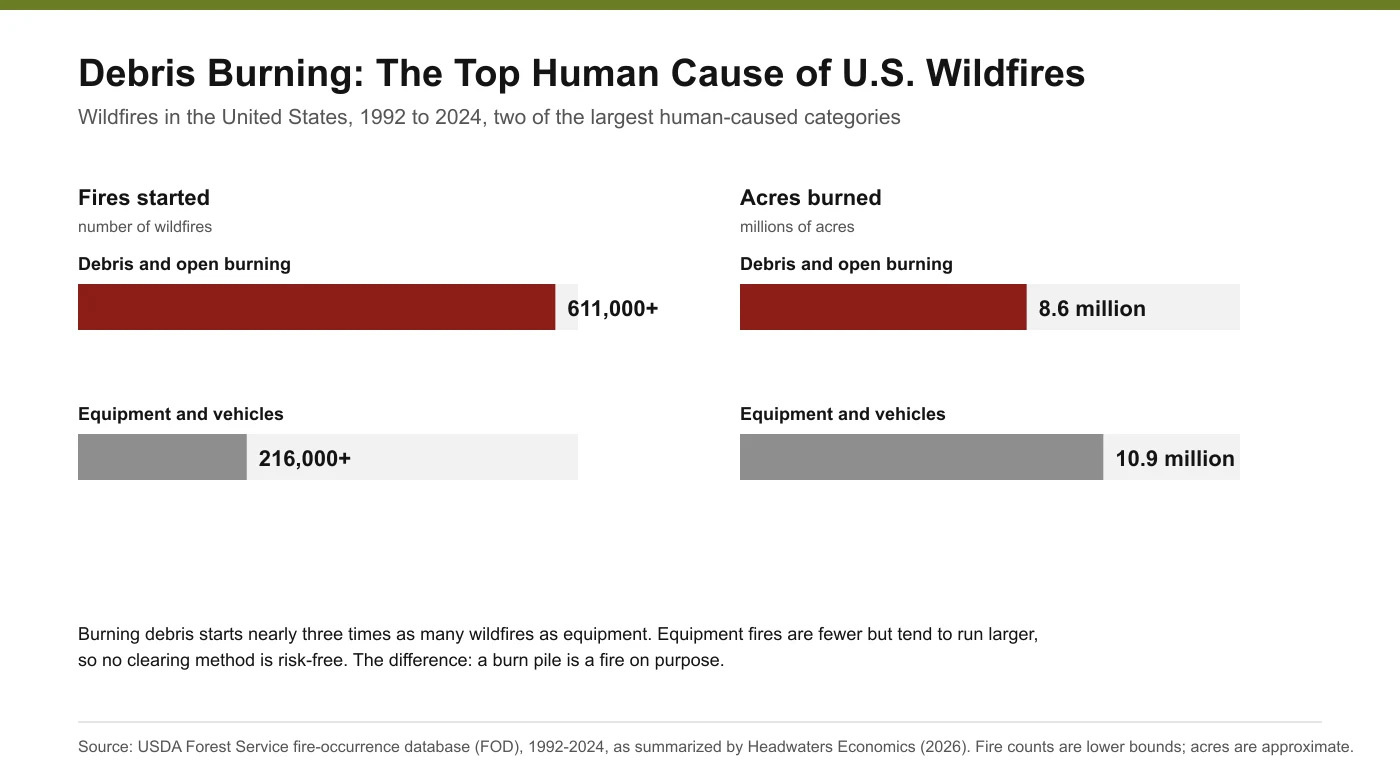
To be fair about it, the same data counts more than 216,000 fires started by equipment and vehicles, and those fires burned more total acres. No clearing method is risk-free, and running heavy equipment on a dry day takes care. The difference is that a burn pile is a fire on purpose, and a grinder is not.
What’s left when you grind it
When the brush goes through a grinder, what’s left is wood chips. On most jobs they can stay on the property, spread as a layer that holds soil in place, or be hauled off when the ground has to be clean for building. There is no ash, no burn scar where the pile sat, and no smoldering pile anyone has to keep watching. Forestry mulching does the same thing in place for brush and smaller trees, and we compared the two methods in forestry mulching vs. traditional land clearing.
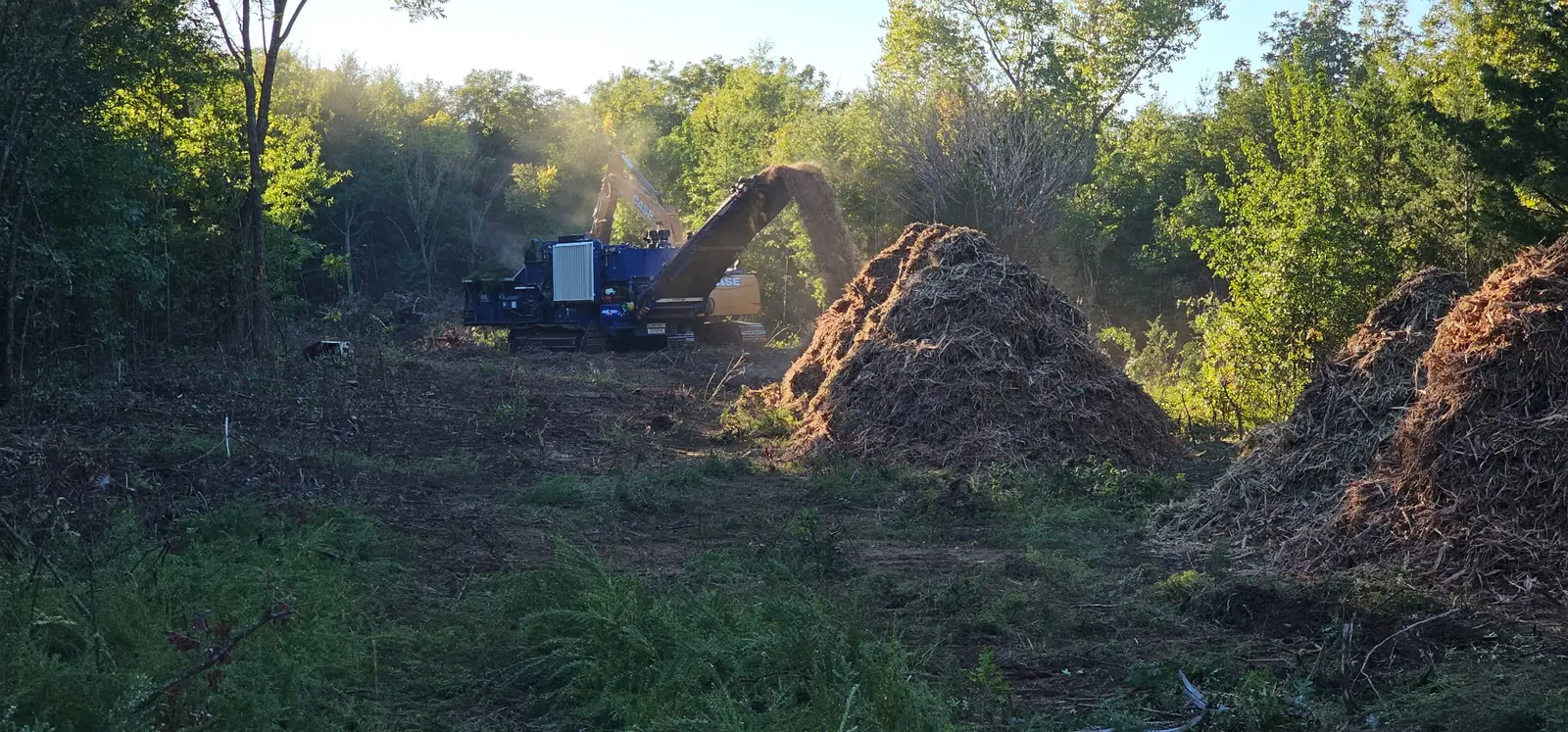
When the site has to be clean for construction, the ground material leaves on trucks instead of going up in smoke.
Burn or grind: how to decide
| Burning | Grinding | |
|---|---|---|
| Up-front cost | Usually lower | Usually higher |
| Schedule | Depends on burn bans, air alerts and the daylight window | Runs on the job’s schedule |
| Burn ban days | Equipment waits on your property | No effect |
| Legal limits | 500 feet from homes, daylight start, no alert days, incinerator in the largest counties | None of those apply |
| Fire risk | An open fire by design | No open fire; equipment still needs care on dry days |
| What’s left | Ash and burn spots | Wood chips, kept as ground cover or hauled off |
Grinding is mechanical land clearing all the way through: the brush is handled by machines from the first cut to the last chip, with no fire in the plan. Burning can still make sense on big, remote acreage far from any house, on a legal burn day, when the owner wants the lowest up-front number and can afford to wait out the weather. We do it. We just don’t recommend it for most jobs, and almost never in a dry Oklahoma fall.
Land clearing without burning across the OKC metro
We do land clearing, grinding and brush clearing across the Oklahoma City metro and about 150 miles around it, with our own grinders and our own crews. If you’re planning a clearing job this fall, burn bans are part of the plan whether you like it or not. If you are clearing cedar on 20 acres or more, a state cost-share program may help pay for mechanical removal, but its application window closes November 1.
You shouldn’t burn it. Grind it. Estimates are free and done on site. Call (405) 465-2809 or request an estimate.